
The Hargis Years
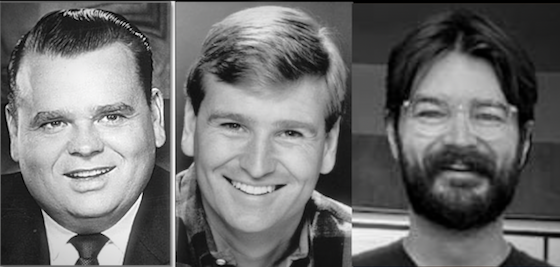
Who Is the Hargis Family?
Billy Hargis II holds the distinction of being OOM-A-GOG's longest caretaker. Although I never knew Billy personally, I was familiar with the legacy of his father, Rev. Billy James Hargis. This article draws primarily from secondary sources — obituaries, historical archives, and a 1993 Tulsa World profile of Billy II himself — but the aim is to provide a clearer, fact-checked narrative of how OOM-A-GOG eventually left Tulsa, and how one family's unusual connection preserved a piece of local television history.
The Man Behind the Ministry
To understand how OOM-A-GOG ended up with the Hargis family, it helps to start with Rev. Billy James Hargis himself. Born in Texarkana in 1925 and adopted by a railroad worker and his wife, Hargis grew up poor during the Depression. As a boy, he promised to devote his life to Christ if his gravely ill adoptive mother recovered — she did, and he was ordained a minister at just 17.
In 1950, Hargis founded Christian Crusade, an anti-Communist ministry that grew into a broadcasting empire — at its peak reaching over 500 radio stations and 250 television stations nationwide. He built a small media complex in Tulsa around it, including a college, a newspaper, and a radio station. In 1953, he gained international attention with the Bible Balloon Project, floating scripture-laden balloons over the Iron Curtain toward Czechoslovakia, Poland, East Germany, and the Soviet Union.
Hargis's anti-Communist crusading shaded into open segregationism, and it drew serious federal scrutiny. In 1960, the FBI investigated him over a series of bombings targeting Little Rock's public schools the year before, as well as an alleged plot to bomb Philander Smith College, a historically Black college in the same city. Agents reportedly tracked him meeting with two bombing suspects at a Memphis restaurant, though no charges were ever filed. Despite — or perhaps partly because of — the scrutiny, Bob Jones University awarded him an honorary doctorate the following year.
Hargis's downfall came in 1974, when several students at his American Christian College accused him of sexual misconduct. No charges resulted, but the college closed by 1977 and his ministry never fully recovered its former reach. He denied the allegations for the rest of his life, writing in his 1985 autobiography, My Great Mistake: "I was guilty of sin, but not the sin I was accused of." He kept publishing and preaching in a smaller capacity for another two decades, eventually relocating Christian Crusade Ministries to a farm in Neosho, Missouri, in 1992. His son, Billy James Hargis II, took over the ministry shortly before Rev. Hargis died in Tulsa in 2004, at age 79.
The Robot in the Warehouse
During the 1970s, Rev. Hargis was broadcasting out of KTEW (formerly KVOO), and young Billy would wander the studio between his father's tapings. On one of those walks, he found OOM-A-GOG sitting at the top of a tall shelf in a dark, mostly forgotten storeroom. The station had just been sold to the Scripps-Howard company, and the new out-of-town management had little sentimental attachment to a leftover kids'-show robot. Billy started visiting the storeroom just to look up at it, calling it a sad fate for a robot he remembered as a childhood hero.
The turning point came at Thanksgiving, when Billy's high-school sweetheart was flying home from college. He decided to surprise her at the airport dressed as Oom-A-Gog, and Channel 2's operations manager had no problem letting him borrow the suit for the stunt. With a friend, Gary Blevins, driving a Christian Crusade van, the two hauled the robot out to the terminal at dusk. What happened next caught Billy off guard: total strangers still recognized Oom-A-Gog on sight, asking him to hold their babies and shake their kids' hands, as if a long-lost movie star had wandered through the airport. "It was exhilarating," Billy later said. "I decided then and there that I was going to try and buy him."
He went back to the station and offered the operations manager $250 for the suit — a substantial sum for a young man at the time. Rather than take the money, the station simply gave Oom-A-Gog to him outright.
Preservation and Restoration
Billy Hargis II treated OOM-A-GOG as one of his most prized possessions, and eventually set out to restore the robot's chest logo to how it looked on the original show. It wasn't a simple job. The logo had been painted over years earlier, and when his sister searched the old Channel 2 files for a reference photo, she couldn't find one. Billy tried to recreate it freehand, following the raised outline of the lightning bolt under the old paint with fresh yellow — but he only made a mess of it, and couldn't undo his own botched paint job.
The fix came almost by accident. Digging through the house for a solution, he and his wife found a can of Liquid Sandpaper left behind by the home's previous owners. It stripped away not only his new yellow paint but also a layer of copper paint applied years before — revealing the original 1950s logo underneath, fully intact. He also appears to have repaired some of the robot's internal wiring to keep it functional. Not everything survived, though: OOM's painted-cloth gloves and boots deteriorated over time, and other pieces — the operator's pants, the nose, the antenna, and the chest power meter — were lost along the way.
Billy Hargis II: A Life of His Own
Beyond his connection to OOM-A-GOG, Billy Hargis II built a full life and career independent of his father's ministry. Born July 28, 1954, in Tulsa — an 11-pound baby delivered at Hillcrest Hospital — he attended Barnard Elementary and Edison High School, where he was an active thespian and served as the 1972 senior class president. He went on to American Christian College, touring the country as a member of the school's choir, "The All-American Kids," before earning a psychology degree from the University of Tulsa in 1978.
His career afterward blended broadcasting, ministry, and performance. He served as general manager of Christian radio station KDLF in Port Arthur, Texas, and contributed regularly to the Christian Crusade newspaper. He also worked steadily as an actor, appearing in national and regional TV commercials and print and billboard ads — including, memorably, a Blue Bell Ice Cream Bar box, dressed as a police officer. Onstage, he took leading roles with the Beaumont Civic Opera, Port Arthur Little Theater, and later the Houston Grand Opera's "Opera to Go" program and the Houston Gilbert & Sullivan Society. He also spent years as a song leader in the choir at Houston's First United Methodist Church.
When Rev. Hargis died in 2004, Billy II took over management of the Christian Crusade ministry. Alongside all of this, he remained a lifelong collector of comic books, cartoon art, and pop-culture memorabilia — and, by his family's own account, OOM-A-GOG stayed one of his most prized possessions right to the end.
Passing the Torch
Billy Hargis II died on September 8, 2013, in Houston, survived by his mother, Betty Jane Hargis; his son, Billy Hargis III; his step-daughter, Mary Olivia Macgowan; their mother, Lucy Cain Hargis; and his three sisters. Stewardship of OOM-A-GOG passed to Billy Hargis III. The robot was no longer displayed, but he wasn't discarded either — he was carefully stored away in a garage in Houston, quietly preserved, if no longer seen, until the search that eventually brought him home to Tulsa.